
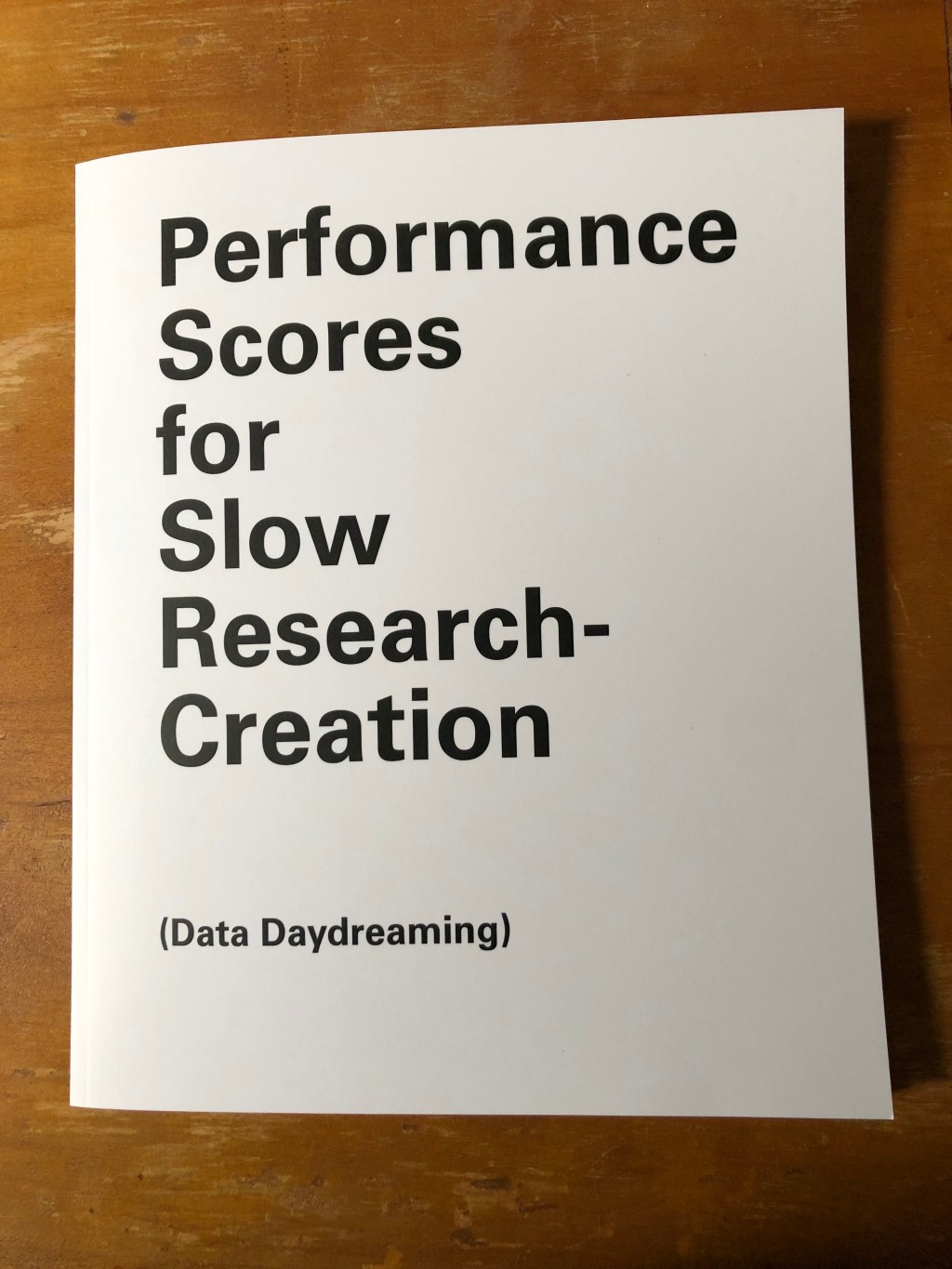
Performance Scores for Slow Research-Creation: (Data Daydreaming) is the culmination of a research-creation doctorate carried out within the Department of Art Education at Concordia University, in Tiohtià:ke/Mooniyang/Montreal, Quebec. As the creation component of my dissertation work—an investigation into the pedagogical (and revolutionary) role of rest, slowness, idleness, and refusal within performative practices, along with the social justice implications of integrating rest in the post-secondary studio art classroom—these scores are the distilled embodiments of observations offered by the 15 fieldwork participants who generously contributed their presence, activations, and reflections.
This publication is both a performance document and an art act: the performance score as poetic/analytic/creative revisiting of moments of being together in restful contemplation and in contemplation about rest. It is an artwork that proposes a conceptual/performative action. These performance scores—as artful, experimental analysis and synthesis of the data—let the data speak on its own terms, within the terms laid out by my research questions’ commitment to (restful, slowed down) acts of social justice.
This thing I am calling “data,” a collection of richly hued diverse textures, ideas, voices, memories, instances, and insights, exists because of the privileged space/time shared with such thoughtful individuals: the Slow Lab participants (Eli Bjedov-Stankovic, Rose de la Riva, Isa Fuentes, Claudia Gomez Juncal, Eddying Jackson, Diana Lukic, Elizabeth Ly, Georgia Mansey, Sandra Michaud, Maddison Schmitt, Annik St-Arnaud), and the Rest-Oration participants (Ryan ‘twinkle’ Backer, Po B. K. Lomami, Salima Punjani, and Coral Short).
The publication was designed in collaboration with Mathilde Martel-Coutu and produced in residence at Centre SAGAMIE in Alma, Quebec. Its production was made possible through a professional development grant with CUPFA-Concordia. The overall project draws on research supported by the Social Sciences and Humanities Research Council of Canada (SSHRC).
A link to the PDF version will be available in early 2027 and a book launch is also scheduled for this coming winter in Montreal. Stay tuned.

